
Seventy years.
One island.
One purpose.
In 1955, one man began growing aloe on a volcanic island off the coast of South Korea. What started as a single farm has become one of Korea's most beloved skincare legacies — trusted by over ten million people across the world.
Kim Jeong Moon —
the aloe farmer
who changed skincare
In 1955, Korea was rebuilding after the Korean War. Skincare as a commercial industry barely existed. It was in this environment that Kim Jeong Moon — a farmer on the volcanic island of Jeju — began cultivating aloe vera with a philosophy radically different from anything the industry would later adopt: grow slowly, harvest purely, and never compromise on the plant.
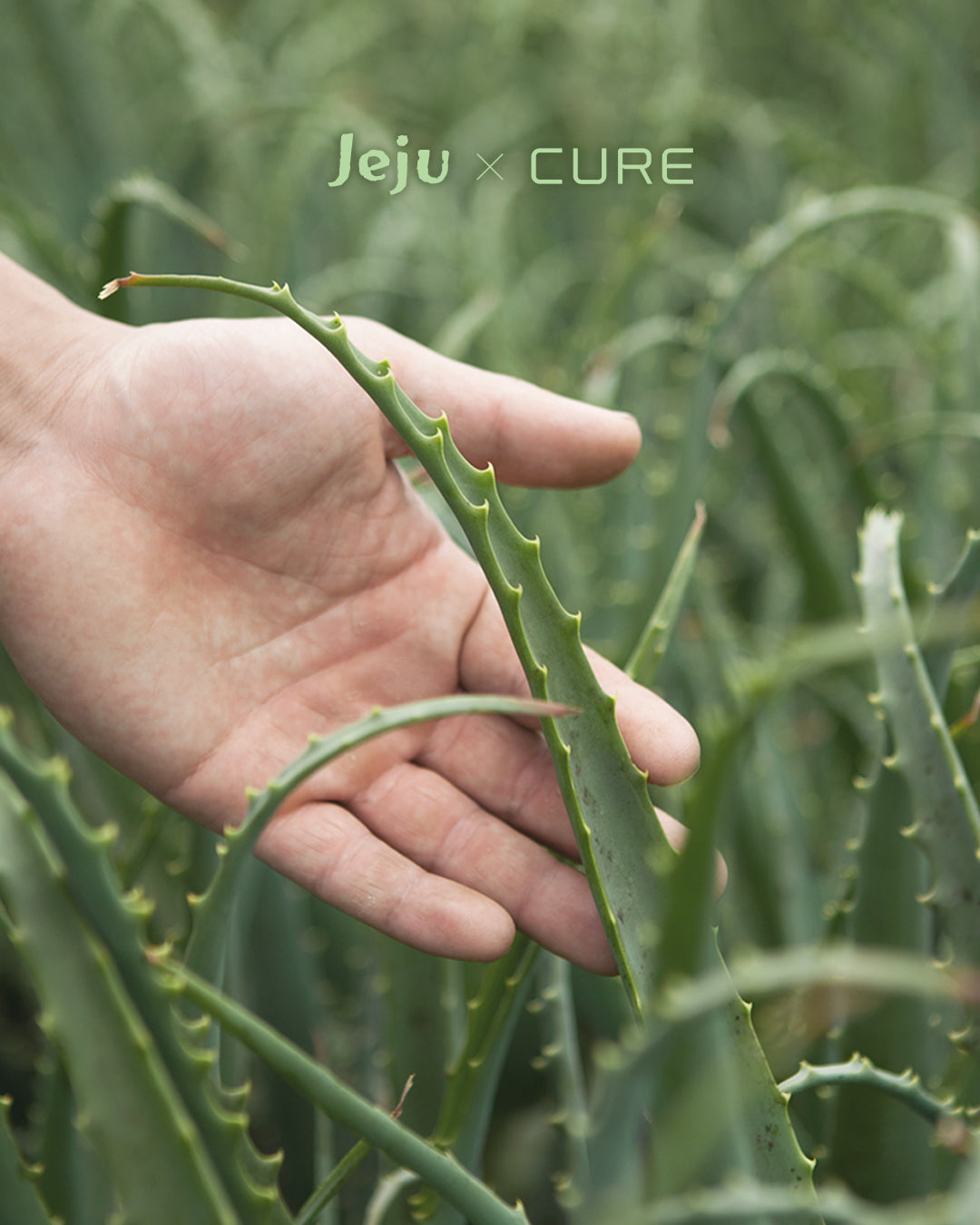
Kim Jeong Moon recognized what Jeju's unique volcanic soil could do. Rich in minerals, naturally alkaline, and porous from centuries of volcanic activity — it produced aloe vera unlike anything grown commercially elsewhere. He committed to growing each plant for nearly 1,000 days before harvest, a timeline that most commercial farms would find economically impossible.
"The aloe does not need to be rushed. Jeju has already given it everything it needs. Our only job is patience."
His belief was simple: if you start with the purest, most concentrated aloe in the world, you don't need to hide it behind water, fillers, or synthetic additives. The plant is the product. That philosophy — unchanged in 70 years — is why CURE still lists aloe as its primary ingredient on every formulation today.

From one Jeju farm
to ten million sold
Kim Jeong Moon begins cultivating aloe vera on Jeju Island, South Korea. He develops his core philosophy: grow each plant for 1,000 days in Jeju's volcanic soil, harvest at peak concentration, and extract without dilution. At the time, no commercial skincare brand operated this way.
Kim Jeong Moon and his team develop their proprietary U-TECH extraction method — a process that isolates only low-molecular-weight aloe compounds from fresh leaves. This allows the active ingredients to penetrate deeper into the skin than standard aloe extracts. This technology becomes the scientific backbone of every CURE product.
The first CURE cream formulations reach Korean consumers. Word spreads through families, dermatologists, and beauty professionals. Unlike water-heavy creams of the era, CURE's concentrated aloe balm delivers results people can feel immediately. The brand develops a loyal following that passes the product down through generations.
CURE expands beyond the original cream to include toners, cleansers, ampoules, and foot care — all built on the same Jeju aloe foundation. Every new formulation begins with the same question Kim Jeong Moon asked at the start: does this make the aloe better, or does it dilute it? If the answer is the latter, the formula doesn't ship.
As Korean skincare becomes a global phenomenon, international buyers discover CURE. The brand that predated K-Beauty by half a century becomes one of its most compelling heritage stories. Sales accelerate across Asia, Europe, and North America. Total units sold surpasses five million — and continues to climb.
CURE by Kim Jeong Moon Aloe surpasses 10 million units sold worldwide. The brand selects its first official Canadian retailer — KJM Aloe Canada — to bring authentic Jeju aloe skincare directly to Canadian customers. Same product. Same Jeju soil. Shipped from Canada, no middleman markup.
Jeju Island —
where the aloe
grows differently
Jeju Island is a UNESCO World Heritage site off the southern coast of South Korea, formed by volcanic activity over millions of years. Its soil is unlike almost anywhere else on earth — mineral-rich, naturally alkaline, and porous from the volcanic basalt rock beneath the surface.
Aloe vera planted in Jeju's volcanic soil absorbs a significantly higher concentration of nutrients than aloe grown in conventional agricultural land. The result is a leaf with exceptional gel density, higher natural polysaccharide content, and a more complex nutritional profile.
1,000 days of growth
Every aloe plant is cultivated for nearly three years before harvest. This slow growth cycle produces exceptional leaf density that cannot be replicated at commercial growing speeds.
Volcanic soil advantage
Jeju's basalt-derived soil is naturally rich in trace minerals. Aloe grown here develops higher concentrations of vitamins, amino acids, and polysaccharides than commercially farmed varieties.
UNESCO protected environment
Jeju is one of only a handful of places on earth to receive UNESCO's triple designation — World Heritage Site, Biosphere Reserve, and Global Geopark. The island's strict environmental protection ensures the aloe grows in genuinely clean conditions.
A heritage brand the world caught up to
Units sold worldwide
Over ten million CURE products have been sold globally — making it one of Korea's most successful skincare brands by volume, with a customer base that spans multiple generations and continents.
Years before K-Beauty was a trend
CURE predates the global K-Beauty movement by more than half a century. When the world discovered Korean skincare, CURE was already a trusted household name across Korea — passed down through families for decades.
Official Canadian retailer
KJM Aloe Canada is the only authorized retailer of CURE by Kim Jeong Moon Aloe in Canada. Direct from Jeju to you — fresh stock, no middleman, and at a price well below what third-party Amazon sellers charge.
See the farm.
Meet the story.
A short documentary filmed on Jeju Island — following the aloe from volcanic soil to finished product. Originally in Korean, English subtitles available. Click CC to enable.
Watch the documentary — add your YouTube URL in theme settings
To add your YouTube video: paste the embed URL into the Video URL field in theme settings for this section · English CC available via YouTube's built-in subtitles
What has never changed
in 70 years
Aloe first — always
Every CURE formulation lists Jeju Island aloe as the primary ingredient — not water, not glycerin, not a filler. The aloe is the product. Everything else serves the aloe. This is not a marketing claim. It is the ingredient list.
1,000 days or nothing
Every aloe plant grown for CURE is cultivated for nearly three years before harvest. This timeline is economically inefficient and commercially impractical for most brands. We do it anyway — because it's the only way to produce the concentration our products require.
No unnecessary additives
No artificial fragrance. No parabens. No synthetic colorants. No ingredients added for marketing value rather than skincare function. Kim Jeong Moon's original question still guides every new formulation: does this make the aloe better, or does it dilute it?
Now available
in Canada
We are Canada's only authorized retailer of CURE by Kim Jeong Moon Aloe. Same product sold on Amazon by third parties for $45+ CAD — direct from us, at a price that reflects what it should actually cost. Fresh stock. Ships from Canada in 1–2 business days.
Shop all CURE products